By Mees de Beukelaar
How Metadata Impacts TikTok SEO
How captions, hashtags, on-screen text, speech and filenames drive TikTok search rankings so smaller creators can get found and convert.
Originally published December 22, 2025

In this article
Metadata is the backbone of TikTok SEO, helping the platform understand, rank, and deliver your content to the right audience. With TikTok now handling over 140 billion searches annually and used by 51% of Gen Z as a search engine, optimizing metadata is key to success. Here’s what you need to know:
- Metadata elements like captions, hashtags, on-screen text, spoken words, and filenames help TikTok categorize your videos.
- TikTok’s Search Algorithm prioritizes metadata over engagement metrics, making it possible for creators with fewer than 10,000 followers to rank high in search.
- Tools like Natural Language Processing (NLP) and Optical Character Recognition (OCR) analyze captions, text, and speech for indexing.
- Videos with optimized metadata (e.g., targeted keywords in captions and text overlays) see up to 8× more search impressions.
- Hashtags using the "3–5 Rule" (specific keywords, category tags, niche tags) can boost discovery and conversions by over 340%.
Key Takeaway: Metadata optimization isn’t optional - it’s how TikTok decides if your content matches search intent. Use keywords strategically in captions, hashtags, and spoken text within the first few seconds of your video. This approach levels the playing field, allowing smaller accounts to compete effectively.
TikTok SEO Tutorial - Optimize your Business Page (10 Simple Tricks!)
How TikTok's Algorithm Uses Metadata
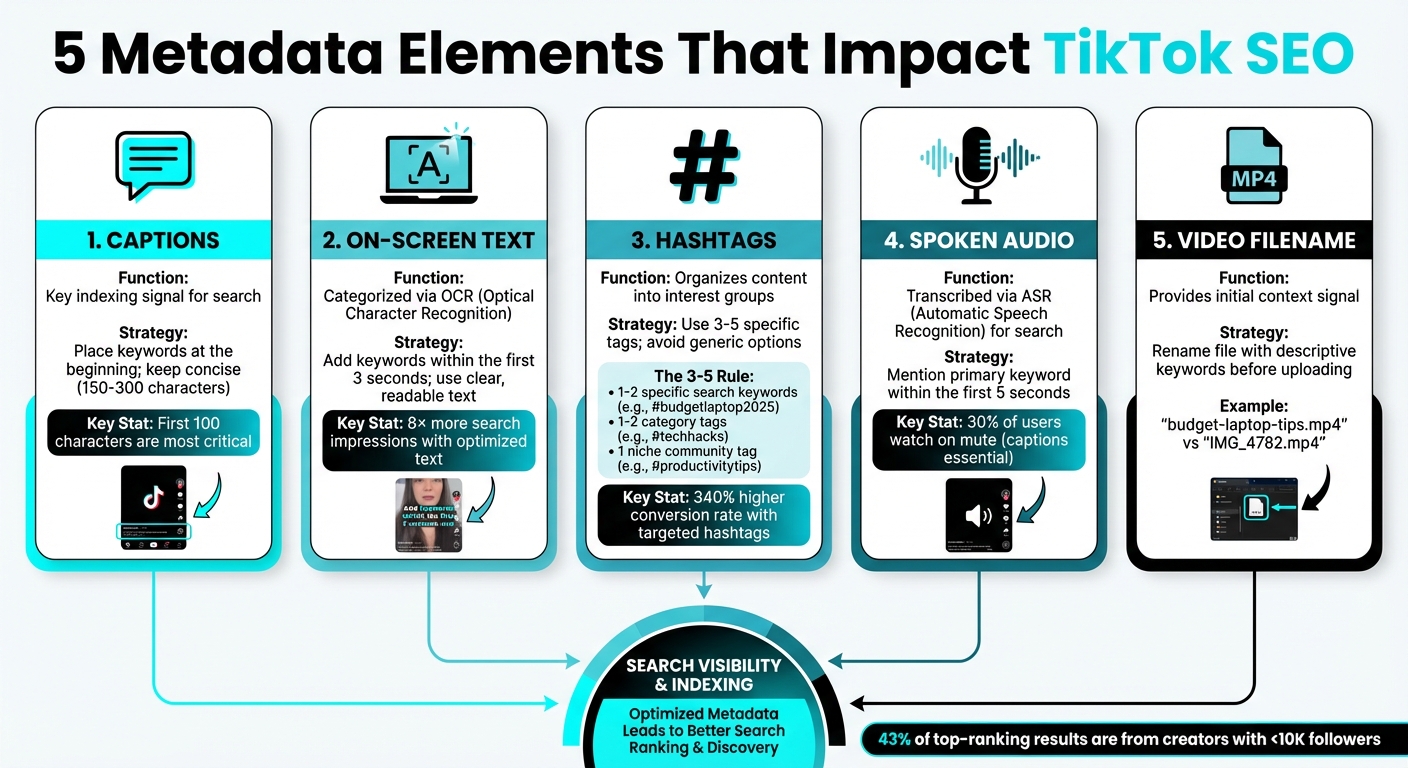
TikTok Metadata Elements: Functions and Optimization Strategies
Metadata plays a crucial role in how TikTok's algorithm understands and ranks content. The platform uses advanced technologies like Computer Vision, Natural Language Processing (NLP), and metadata analysis to break down your videos into searchable components. These tools work together to identify visual elements, transcribe spoken words, and process textual inputs, creating a detailed profile of your content. This multi-layered analysis feeds into a ranking system that balances user engagement with precise metadata alignment.
TikTok prioritizes ranking signals in three tiers based on their impact: User Interactions (watch time, shares, saves) carry the most weight, followed by Video Information (captions, hashtags, on-screen text, audio), and finally User Settings (language, location, device type), which have the least influence. While engagement is key for sustained visibility, accurate metadata ensures your video reaches the right audience.
"TikTok's search algorithm weighs the beginning of your caption more heavily. Don't bury your keyword in sentence three." - Synergist Digital Media
Captions and Text Overlays
The first sentence of your caption - especially the first 100 characters - is critical for indexing. Including your primary keyword upfront helps the algorithm quickly understand your video’s focus. For instance, starting a caption with "5 budget travel hacks for Europe under $50/day" signals relevance right away.
TikTok’s Optical Character Recognition (OCR) technology also scans on-screen text, treating it as searchable metadata. Videos with optimized text overlays have been shown to receive up to 8× more search impressions over 30 days compared to those with generic text. To maximize this, include keywords within the first 3 seconds of your on-screen text, as these frames are integral to establishing your video's topic.
Additionally, TikTok uses Automatic Speech Recognition (ASR) to transcribe spoken audio into searchable text. Clearly stating your target keyword within the first 5 seconds of your video strengthens its metadata signals. With over 30% of users watching videos on mute, enabling accurate auto-captions is essential - not just for accessibility but also for ensuring your content is properly indexed.
Hashtags and Content Discovery
Hashtags are another powerful tool for categorizing your content, helping the algorithm place your video in relevant interest groups like #BookTok or #STEMTok. Using a targeted hashtag strategy, known as the "3–5 Rule", can significantly boost your visibility. This involves:
- 1–2 specific search keywords (e.g., #budgetlaptop2025)
- 1–2 category tags (e.g., #techhacks)
- 1 niche community tag (e.g., #productivitytips)
This approach has led to impressive results, with videos achieving 78% more search views and a 340% higher conversion rate compared to those using generic tags. For example, TechDaily optimized their product review videos with targeted hashtags, resulting in 2.4 million monthly search views, with 89% of their traffic coming directly from search.
Consistent use of specific hashtags not only enhances discoverability but also helps establish authority within your niche.
Video Filenames
Even the name of your video file can influence TikTok’s algorithm. Before uploading, renaming your file to include relevant keywords - like "budget-laptop-tips.mp4" instead of "IMG_4782.mp4" - provides an initial context signal. While less impactful than captions or on-screen text, this simple step can still contribute to better discoverability.
Metadata Element Function Strategy Captions Key indexing signal for search Place keywords at the beginning; keep concise (150–300 characters) On-Screen Text Categorized via OCR Add keywords within the first 3 seconds; use clear, readable text Hashtags Organizes content into interest groups Use 3–5 specific tags; avoid generic options Spoken Audio Transcribed via ASR for search Mention primary keyword within the first 5 seconds Video Filename Provides initial context signal Rename file with descriptive keywords before uploadingResearch Findings on Metadata Optimization
How Different Metadata Elements Impact Rankings
Optimizing metadata plays a key role in improving TikTok search performance. A field experiment conducted from August 8 to 21, 2023, analyzed over 2 million videos and revealed that AI-generated titles increased valid watches by 1.6% and watch duration by 0.9%. When creators fine-tuned these AI titles, valid watches jumped by 7.1%, and watch duration rose by 4.1%.
Interestingly, every 10% decrease in similarity between an AI-generated title and its human-edited version correlated with a 9.8% increase in viewership and a 9.2% improvement in watch duration. This shows that while AI provides a solid foundation for metadata, human adjustments that add nuance and personality yield far better results.
Another experiment compared identical videos and found that keyword-rich on-screen text generated 8× more search impressions over 30 days. This underscores the importance of TikTok's Optical Character Recognition (OCR) technology, which actively reads and indexes on-screen text as a critical ranking factor.
These findings lay the groundwork for real-world examples that illustrate how metadata optimization drives tangible results.
Case Studies from Creators and Businesses
TechDaily refined metadata for over 200 videos, resulting in 2.4 million monthly search views, with 89% of those views coming from search alone.
Similarly, Glossier employed a targeted metadata strategy by creating tutorials optimized for specific product-related searches, such as "how to use cloud paint." Their efforts consistently secured top-three rankings for dozens of product-related queries, delivering a 340% ROI on TikTok content. Impressively, 67% of their TikTok-driven sales originated directly from search traffic.
A personal finance creator demonstrated the potential of search optimization with a single video titled "Best high-yield savings accounts 2025." This video ranked #1 for its target query, amassing 3.8 million views in six months, with 92% of those views coming from search. The post generated $47,000 in affiliate commissions.
One key takeaway from these examples: 43% of top-ranking TikTok search results are from creators with fewer than 10,000 followers. This proves that relevance in metadata often outweighs follower count when it comes to search success.
sbb-itb-5598afdUsing OpenClip to Optimize Metadata
Automating Metadata with OpenClip
Accurate metadata plays a huge role in making content discoverable, and OpenClip takes the guesswork out of it by automating the process. Its AI transcription engine turns spoken audio into searchable text, ensuring captions and transcripts are packed with relevant keywords. Since TikTok's algorithm scans these transcripts to connect videos with user searches, this automation gives your content a better chance of being found. OpenClip also uses AI-driven captioning to craft descriptive text from video frames, ensuring keywords are consistently placed in captions, on-screen text, and even filenames - key factors TikTok relies on for ranking content.
Another standout feature is OpenClip's ability to create vertical clips in TikTok’s 9:16 format while keeping metadata like hashtags and descriptions intact across all clips. It doesn’t just stop at transcription and captioning; OpenClip also helps fine-tune your posting strategy and editing workflow for better results.
Repurposing Content for TikTok Efficiently
Once your metadata is optimized, timing becomes everything. OpenClip’s scheduling tool lets creators post videos at peak times when their audience is most active, increasing the chances of better engagement. Pairing this with a consistent posting schedule - ideally 3 to 5 times per week - ensures that metadata-optimized videos reach viewers when they’re most likely to interact.
To make things even easier, OpenClip offers text-based editing and tools to remove filler content, speeding up the clip creation process while improving TikTok SEO. For those on Pro and Business plans, priority queues help boost production speed, ensuring a steady stream of search-friendly content is always ready to go.
Conclusion: Using Metadata to Improve TikTok Performance
Metadata isn't just a technical aspect of content creation - it's the key to connecting your videos with users actively searching for them. With 51% of Gen Z now turning to TikTok as their go-to search engine, optimizing elements like captions, hashtags, on-screen text, and spoken keywords is critical for ensuring your videos are found rather than overlooked. Unlike passive scrolling, search-driven traffic often brings higher commercial intent, making metadata optimization a must for creators and businesses alike.
Data shows that relevance can outshine popularity, with smaller accounts outperforming larger ones when metadata is thoughtfully optimized.
Here’s how you can take your metadata game up a notch:
- Keyword Placement: Place essential keywords in the first 100 characters of your caption and within the first three seconds of your on-screen text.
- Hashtag Strategy: Stick to 3–5 hashtags, balancing 1–2 specific search terms, 1–2 category tags, and 1 niche community hashtag.
- Speech-to-Text Indexing: Mention your target keyword within the first five seconds of your video to ensure accurate indexing.
- Encourage Saves: Use calls-to-action like "Save this for later", as saves are currently the strongest signal for search rankings.
Tools like OpenClip can simplify this process by automating transcriptions and creating keyword-rich captions, ensuring your metadata is consistent across all your content. Pair this with strategic posting during peak engagement times, and you’ll build a library of search-optimized videos that continue to attract views and conversions long after they’re published.
The trend toward search-focused content is only gaining momentum. By treating metadata as a core part of your strategy, instead of an afterthought, you can create content that generates traffic for months - or even years - without relying on fleeting viral trends.
FAQs
How do hashtags improve TikTok SEO and help my videos get discovered?
Hashtags play a crucial role in helping TikTok understand what your video is about and connecting it with the right audience. By using relevant hashtags, you can improve your video’s chances of showing up in search results and landing on the For You page, giving it a better shot at being seen. Considering TikTok handles billions of searches annually, choosing the right hashtags can heavily influence your video’s performance.
To get the most out of hashtags, aim for a mix of broad, popular ones and more specific, niche tags about your topic. Stick to 3–5 carefully chosen hashtags per video, and make sure the most important one appears early in your caption. Keep an eye on how your posts perform to figure out which hashtags are driving engagement, and adjust your strategy as trends shift. Tools like OpenClip can help by analyzing your content and recommending optimized hashtags, saving you time while improving your reach.
Why is metadata more important than engagement for TikTok discoverability?
Metadata is a key factor in how TikTok's search algorithm decides which videos to rank and display. Elements such as titles, descriptions, hashtags, and other metadata help TikTok assess how well a video aligns with what users are searching for. While engagement metrics like likes and shares are crucial for landing on the For You page, they carry less weight when it comes to searchability.
If you want your videos to be easier to find and reach the right audience, focus on optimizing your metadata with relevant keywords. This simple step can make a big difference in boosting your video's visibility.
Does Optical Character Recognition (OCR) impact TikTok SEO?
While there’s no concrete evidence that Optical Character Recognition (OCR) directly influences TikTok SEO at the moment, it’s worth noting that TikTok’s algorithm prioritizes elements like metadata, captions, hashtags, and user engagement to determine a video’s reach and discoverability.
OCR, which processes text within videos, could potentially play a role in the future by helping TikTok interpret and index on-screen text. However, for now, this idea remains purely speculative.
Turn one video into a week of content.
Try OpenClip free